
I was mid-deployment on a client’s EC2 instance when CVE-2026-21858 dropped into my feed. They were already calling it Ni8mare, and that name made immediate sense. I had three production n8n servers running and two had public-facing webhook endpoints.
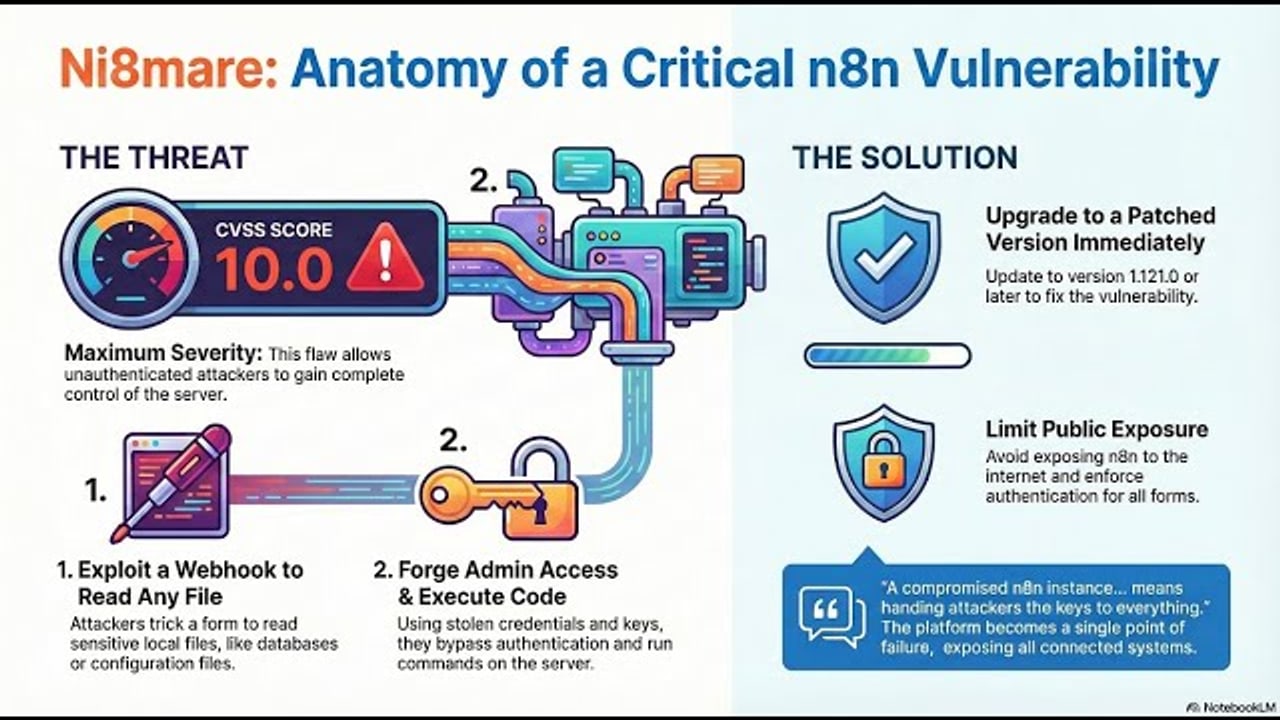
The vulnerability enabled unauthenticated remote code execution on any exposed n8n instance. No credentials, no prior access, no social engineering required. A single crafted HTTP request was sufficient to execute arbitrary code on the host.
What makes this particularly serious is what n8n instances typically hold. My servers carry credentials for client AWS accounts, Salesforce orgs, and OpenAI API keys. A compromised n8n server is not just a compromised server. It is a direct path into every third-party integration that server has ever touched.
The CVE cluster did not stop at one patch. CVE-2026-25049 bypassed the Ni8mare fix within weeks of release. Then CVE-2026-44789 through 44791 followed, each finding a new angle on the same underlying exposure. Patching and repatching without understanding the architecture underneath felt like plugging holes in a net.
The n8n documentation recommended setting EXECUTIONS_PROCESS to main and enabling basic authentication as hardening steps. I applied both on two of my instances after Ni8mare broke. Those steps were not sufficient to block CVE-2026-44789, which exploited a different code path entirely. The docs had been updated for the first CVE but had not yet caught up with the bypass chain.
What actually worked required changes at multiple layers, not just the n8n configuration. I moved every instance behind a VPN and stripped out direct public webhook exposure. Then I rotated every credential each server had ever touched, starting with AWS and OpenAI.
Rotating credentials sounds simple until you realize how many places each key appears. My instances had been running for over a year, connecting to services across multiple client accounts. The AWS credentials alone required updating IAM policies, regenerating access keys, and testing twelve workflows that depended on them. That is the hidden cost of a breach scenario that nobody includes in the self-hosting pitch.
Security researchers estimated approximately 100,000 n8n servers were exposed during the Ni8mare window. That number reflects how widely n8n has been adopted as production infrastructure over the last two years. Most of those instances were not hardened because the hardening guidance assumed a threat model that did not include RCE.
The n8n team released patches quickly after each disclosure, which is worth acknowledging. The problem was that each patch addressed the specific exploit path without closing the underlying mechanism. The community found the bypass to CVE-2026-25049 within days by fuzzing the same endpoint with different payloads.
The risk is compounded by how n8n is being used now versus two years ago. Most of the instances in that 100,000 figure were running AI integrations with OpenAI or Anthropic. An attacker who owns that server can exfiltrate those API keys and generate unlimited completions at your expense.
The automation community has treated self-hosting primarily as a cost and privacy decision. The Ni8mare chain is forcing a more honest conversation about operational security. Most self-hosted n8n instances are maintained by people who are excellent at building workflows but not security engineers.
Nobody audited what their n8n instance could reach before these CVEs dropped. Most people set up credentials when they needed a connection and never revisited them. The result is n8n instances with overpermissioned access to a dozen services they no longer use.
Zapier does not expose you to this class of risk, and I want to be honest about that. When you self-host, you own the security posture entirely, including the parts you did not know needed owning. That is a real cost that should appear in any serious comparison between hosted and self-hosted automation tools.
Does your workflow actually require a public webhook, or is that just the default path you took? Each n8n instance should connect to external services with the minimum permissions that workflow actually needs. Security teams are now flagging n8n instances in penetration assessments as high-priority attack surface, and that is a category shift that matters.
The Ni8mare chain is not an argument against n8n. It is an argument against running production automation infrastructure the way most people currently run it. Public exposure plus broad credential access plus minimal security monitoring is not a self-hosting setup. It is a liability waiting for a CVE to make it visible.

Olaitan Oladipo holds a BSc in Sociology from Olabisi Onabanjo University. He is a self-taught automation builder who has spent years inside n8n doing the work that most tutorials skip: debugging OAuth errors at 2am, migrating client automations from Make.com mid-project, fighting reverse proxy misconfigurations on AWS EC2, and figuring out through trial and error what actually holds up in production versus what only looks clean in a demo.
He is not a developer by training and not a SaaS founder. He is the person in the Discord server who actually answers the question instead of linking to the docs.
His writing on n8n Automation Tutorial covers self-hosting, AI agent workflows, tool comparisons, and the security vulnerabilities the automation industry would rather not discuss. He has built AI-assisted invoice approval flows using OpenAI function calling, connected Claude via HTTP Request nodes, and holds considered opinions about Zapier, Make.com, LangChain, and CrewAI that their marketing teams would not appreciate.
He writes for people who are technical enough to follow a tutorial but experienced enough to want the honest version.