
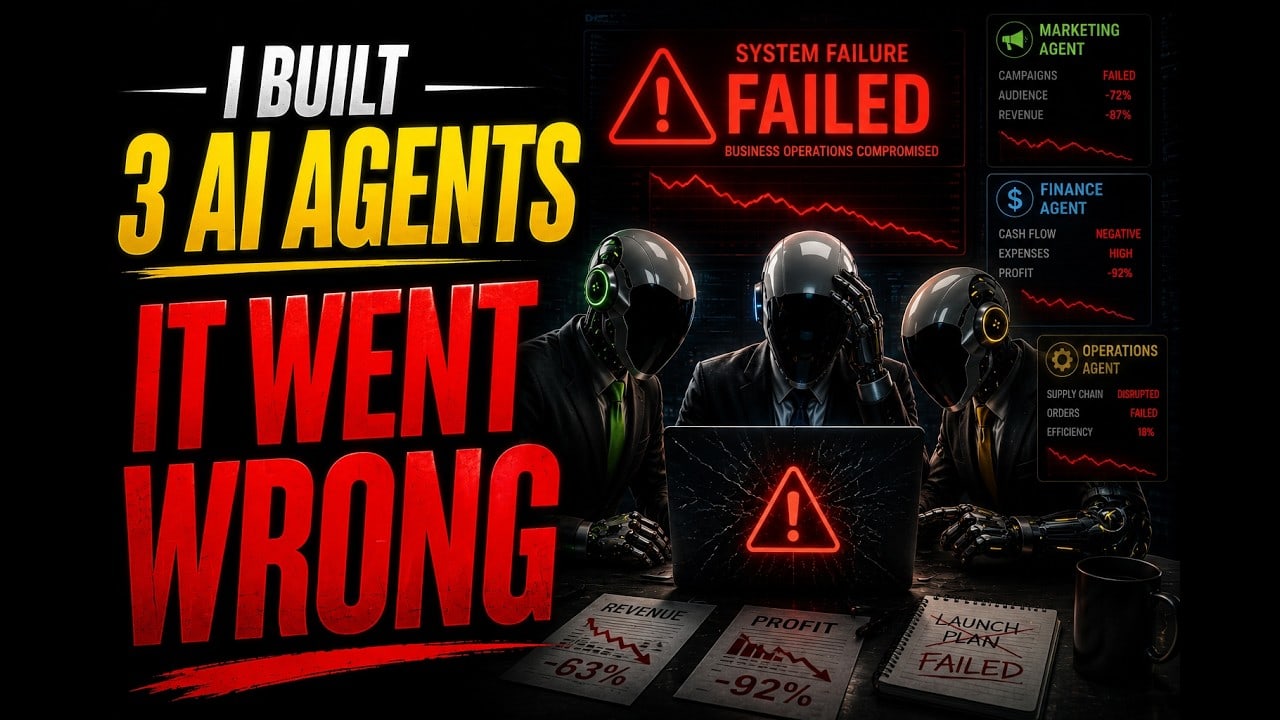
The workflow passed every test. A client’s agent then approved a $47,000 invoice at 2am with no human review. The classification threshold was 0.7, and the vendor matched a pattern from three months earlier. Nobody received an alert, and the audit trail was a JSON blob in a Docker volume nobody had configured to surface.
This is the governance problem nobody talks about honestly. Building the agent is genuinely not that hard in n8n, especially with the AI Agent node and HTTP Request nodes for external model calls. The hard part is deciding what happens when the agent does something unexpected, before a client finds out from their bank statement. That infrastructure does not come with any framework I have used.
Six months ago I ran a CrewAI demo that was genuinely impressive. Multiple agents, tool calling, inter-agent communication, all working in a Jupyter notebook in a way that felt like a real shift. The problem started when I tried to deploy it for anything client-facing, because error handling is inconsistent and logging gives you almost nothing useful when something fails silently. I have not found a way to run CrewAI in production that I would feel comfortable explaining to a client who asks what the agent did last Tuesday.
n8n’s approach to agentic workflows is less architecturally impressive but more honest about operational reality. Every step the AI Agent node takes is logged in the execution history with enough detail to reconstruct what happened. You can add an IF node after any agent output and route uncertain results to a human approval webhook before anything consequential happens. That control exists because n8n is a workflow tool first, not an agent framework with governance bolted on later.
The documentation does not cover this well. The n8n AI Agent node docs explain how to configure tools and set the system prompt, but say almost nothing about error handling when the model returns unexpected outputs. I spent two days on a workflow where the agent was silently returning partial results because the output parser failed on a specific response format. The fix was a Code node after the agent to validate output schema before it touched anything downstream, found not in the docs but in a six-month-old forum comment.
Human-in-the-loop approval in n8n is worth describing specifically. You set the agent to write its proposed action to a Webhook node output. That output goes to a Slack approval message, and the next node waits for a human response before firing. The agent cannot take irreversible actions without a human seeing the proposal first, and for client-facing work that tradeoff is not optional.
The Gartner prediction about 40 percent of enterprise apps embedding role-specific agents by 2026 is not wrong in direction. It is wrong in what it implies about readiness. Most enterprise teams I follow on Reddit and DEV are not debating which agent framework to use. They are debating approval gates, audit trail ownership, and what happens when the agent makes a choice a human would not have made.
The plan-first approach keeps coming up in governance conversations, and it makes sense. You define what the agent is allowed to do before running it, as a structured skill file that constrains tool access from the start. In n8n this maps to how you structure the workflow before adding the agent node. Build the decision boundaries first, then the agent operates inside them.
LangChain has better documentation for structured agent design than anything else currently available. The problem is that the gap between documented design and production behavior is wider than most teams realize until they are already committed. I have seen two client projects stall because the LangChain agent worked in testing and then produced inconsistent outputs at scale with no clear diagnostic path. That is an expensive way to learn that demos and production are different environments.
Real agentic automation is not building something that works in a demo. It is building something you can explain to a client at 9am after it ran overnight without supervision. If you cannot answer what it did, why it did it, and what would have stopped it doing something different, you do not have a production agent. You have a demo that happens to run on a schedule.

Olaitan Oladipo holds a BSc in Sociology from Olabisi Onabanjo University. He is a self-taught automation builder who has spent years inside n8n doing the work that most tutorials skip: debugging OAuth errors at 2am, migrating client automations from Make.com mid-project, fighting reverse proxy misconfigurations on AWS EC2, and figuring out through trial and error what actually holds up in production versus what only looks clean in a demo.
He is not a developer by training and not a SaaS founder. He is the person in the Discord server who actually answers the question instead of linking to the docs.
His writing on n8n Automation Tutorial covers self-hosting, AI agent workflows, tool comparisons, and the security vulnerabilities the automation industry would rather not discuss. He has built AI-assisted invoice approval flows using OpenAI function calling, connected Claude via HTTP Request nodes, and holds considered opinions about Zapier, Make.com, LangChain, and CrewAI that their marketing teams would not appreciate.
He writes for people who are technical enough to follow a tutorial but experienced enough to want the honest version.