


For the previous guide in this series, read n8n vs Node-RED: 6 Key Differences Between a Business Automation Platform and an IoT Workflow Tool in 2026.
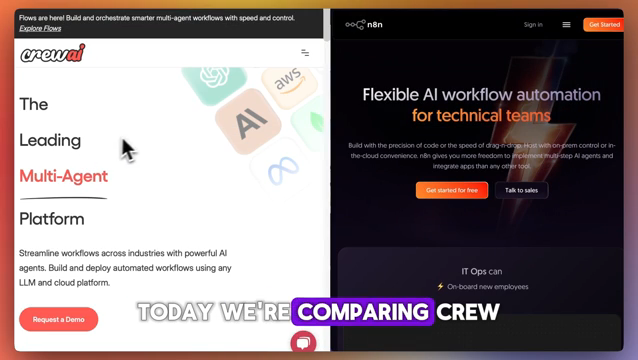
CrewAI is a Python framework for orchestrating collaborative multi-agent AI systems. n8n is a visual workflow automation platform with over 500 integrations that recently added AI agent capabilities. Both tools build AI-powered automation, but they serve different purposes, audiences, and skill levels. CrewAI launched in November 2023. n8n has been active since 2019 and holds over 133,000 GitHub stars, placing it among the top 50 public repositories on GitHub.
What Is CrewAI?
CrewAI is an open-source Python framework for building teams of AI agents that collaborate to complete complex tasks. Each agent is assigned a specific role, goal, and backstory. Agents communicate with each other, delegate subtasks, and coordinate through sequential or hierarchical processes to produce a final output. CrewAI is built around 3 core components:
- Agents – individual AI workers with defined roles such as researcher, writer, or analyst
- Tasks – specific instructions each agent is assigned to complete
- Crews – the coordinated group of agents working together toward a shared goal
In 2024, CrewAI introduced Flows, a feature for building structured, event-driven automations. A Flow can orchestrate a series of steps and embed entire Crews within them, combining deterministic logic with autonomous agent decision-making.
What Is n8n?
n8n is an open-source workflow automation platform that connects apps, APIs, and services through a visual node-based editor. It supports over 500 native integrations and allows users to automate multi-step workflows without writing code. n8n added an AI Agent node to its platform, enabling AI-assisted decision-making within standard automation workflows. n8n describes itself as the open-source alternative to Zapier, but with greater flexibility, self-hosting support, and the ability to run custom JavaScript inside Function nodes. A typical n8n workflow connects a trigger – such as a new row in Google Sheets – to an AI Agent node for analysis, then routes the output to a downstream action such as sending a Slack message.
What Are the 6 Key Differences Between CrewAI and n8n?

CrewAI and n8n differ across 6 dimensions: architecture, coding requirements, integrations, AI depth, pricing, and best use case.
| Feature | CrewAI | n8n |
|---|---|---|
| Primary purpose | Multi-agent AI orchestration | Workflow automation with AI support |
| Coding requirement | Python required | No-code visual builder; optional JavaScript |
| Integrations | LangChain tools and custom APIs | 500+ native integrations |
| AI depth | Full multi-agent collaboration and reasoning | Single AI Agent node within workflows |
| GitHub stars | ~36,000 | ~133,000 |
| Founded | 2023 | 2019 |
How Does Architecture Differ Between CrewAI and n8n?
In CrewAI, the application is the agentic system. In n8n, the workflow is the primary entity and the AI Agent is one node within it. CrewAI builds the entire system around agents collaborating in a crew structure. n8n treats AI as one step in a broader automation sequence. For example, a content pipeline in CrewAI uses 3 agents: a research agent that gathers data, an analysis agent that interprets it, and a writer agent that produces a report. The same task in n8n places a single AI Agent node between data collection nodes and an output node. CrewAI provides more control over agent behavior and reasoning. n8n provides more predictable failure modes and easier debugging.
Which Platform Is Easier to Use?
n8n is easier to use for non-developers because it requires no Python knowledge. Its visual editor allows teams to build complex automations by dragging and connecting nodes. n8n can be set up in self-hosted mode using Docker Compose in under 30 minutes. CrewAI requires Python proficiency. Agents, tasks, crews, and flows are defined in code or YAML configuration files. This makes it more powerful for developers but inaccessible to non-technical teams without engineering support.
How Do Integrations Compare?
n8n supports over 500 native integrations, including Slack, Salesforce, Notion, Google Sheets, and Airtable. These are pre-built nodes with error handling, retry logic, and authentication managed by the platform. CrewAI relies on LangChain tools and custom API connections for integrations. Developers write the integration code directly, which offers full flexibility but requires more engineering time. A data collection script that takes a single node in n8n can become a 200-line Python file in CrewAI.
How Much Do CrewAI and n8n Cost?
Both platforms offer a free tier. CrewAI cloud plans start at $25 per month. n8n cloud plans start at $20 per month. CrewAI pricing breakdown:
- Free – 50 executions per month, 1 deployed crew, 1 seat, includes visual editor and AI copilot
- Professional – $25 per month, 100 executions per month; overages billed at $0.50 per execution
- Enterprise – custom pricing, estimated at $60,000 to $120,000 per year; includes SOC 2, HIPAA compliance and dedicated support
n8n pricing breakdown:
- Community Edition – free, self-hosted, unlimited workflows, no execution caps
- Starter – $20 per month, cloud-hosted
- Pro and Enterprise – custom pricing based on executions and team size
n8n’s self-hosted Community Edition is free with no execution caps. CrewAI’s open-source core is also free, but the no-code builder and advanced monitoring features require a paid cloud plan. For teams that can self-host, both platforms are available at zero licensing cost.
What Are the Real-World Use Cases for Each Platform?
CrewAI is used for multi-step reasoning tasks. n8n is used for connecting business tools and automating predictable workflows. CrewAI use cases include:
- Research pipelines where one agent searches, another analyzes, and a third writes a summary
- Competitive analysis with specialized agents handling different data sources
- Multi-stage content drafting with review and revision agents
- Autonomous problem-solving requiring agent-to-agent delegation
n8n use cases include:
- Lead scoring workflows that pull from a CRM, enrich data with an AI model, and push results to Slack
- Document summarization pipelines feeding into database updates
- Intelligent alert routing across SaaS tools
- Scheduled data pipelines with AI classification steps
Both tools can be used together. n8n can trigger a CrewAI agent crew via HTTP request and pass the results into downstream workflow steps, combining n8n’s integration breadth with CrewAI’s multi-agent reasoning.
CrewAI vs n8n: Which One Should You Use?
Use CrewAI if your team is Python-proficient and needs agents to collaborate, delegate tasks, and reason across multiple steps. It suits research pipelines, competitive intelligence systems, and any workflow where different AI personas contribute specialized expertise toward a shared goal. Use n8n if your team includes non-developers, or if the primary need is connecting apps and services with AI assistance at one or more steps. It suits business automation, data routing, CRM enrichment, and workflows where predictable failure handling matters. 3 decision criteria to choose between them:
- Skill level – n8n for non-developers; CrewAI for Python developers
- Task type – n8n for integration-heavy workflows; CrewAI for reasoning-heavy agent systems
- Budget predictability – n8n offers transparent execution-based cloud pricing; CrewAI enterprise pricing requires a sales conversation


Olaitan Oladipo holds a BSc in Sociology from Olabisi Onabanjo University. He is a self-taught automation builder who has spent years inside n8n doing the work that most tutorials skip: debugging OAuth errors at 2am, migrating client automations from Make.com mid-project, fighting reverse proxy misconfigurations on AWS EC2, and figuring out through trial and error what actually holds up in production versus what only looks clean in a demo.
He is not a developer by training and not a SaaS founder. He is the person in the Discord server who actually answers the question instead of linking to the docs.
His writing on n8n Automation Tutorial covers self-hosting, AI agent workflows, tool comparisons, and the security vulnerabilities the automation industry would rather not discuss. He has built AI-assisted invoice approval flows using OpenAI function calling, connected Claude via HTTP Request nodes, and holds considered opinions about Zapier, Make.com, LangChain, and CrewAI that their marketing teams would not appreciate.
He writes for people who are technical enough to follow a tutorial but experienced enough to want the honest version.


