


For the previous guide in this series, read Blog research and writer n8n workflow: Build An AI System That Writes Viral Posts.
n8n is a business workflow automation platform with 1,000-plus integrations and native AI agent support. Node-RED is a free, Apache 2.0-licensed visual programming tool built for IoT, hardware, and event-driven flows. The core difference is SaaS automation versus edge computing.
What Are n8n and Node-RED?
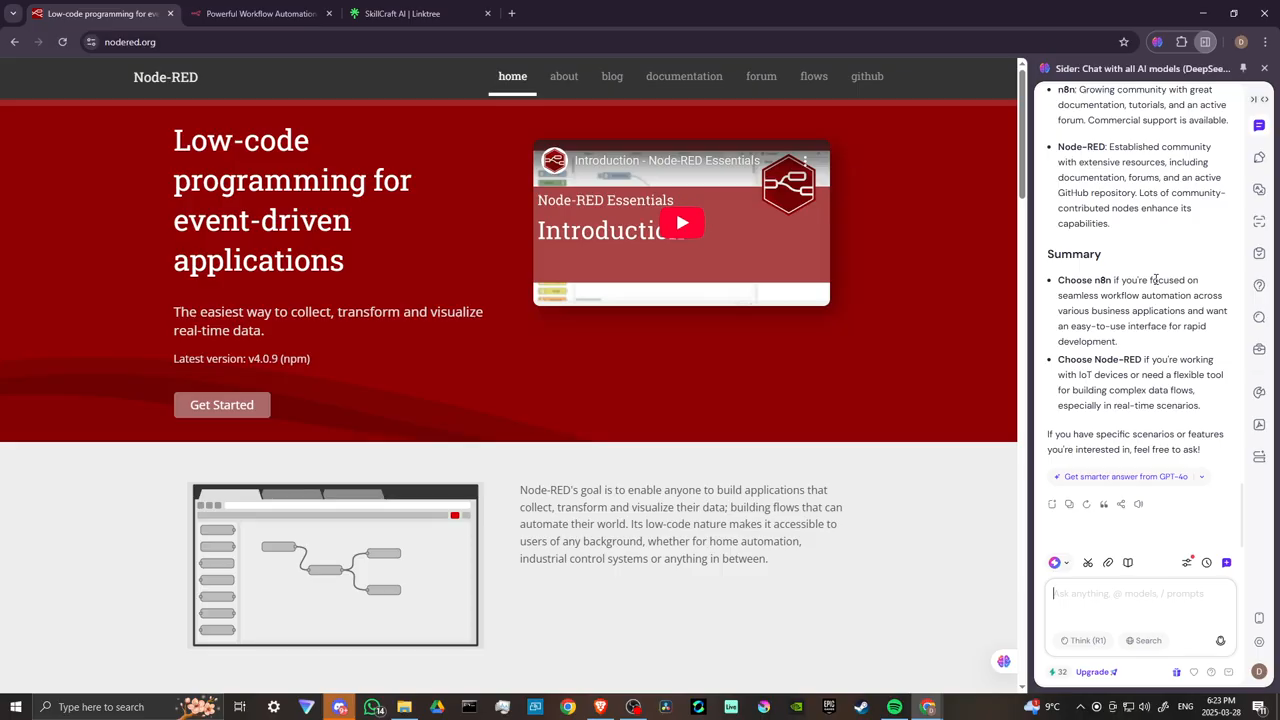
n8n and Node-RED are both open-source, node-based visual automation tools. They share a similar canvas interface but serve fundamentally different use cases. n8n connects cloud apps, APIs, and databases for business process automation. Node-RED connects hardware devices, sensors, and industrial systems for real-time event processing. n8n is a workflow automation platform for technical teams, with 400-plus integrations, native AI nodes, and a strong focus on APIs and SaaS apps. Node-RED started life as IBM’s visual tool for wiring hardware devices, APIs, and online services, especially in IoT and event-driven systems. Node-RED runs on any device where Node.js runs. Examples include Raspberry Pi, Docker containers, industrial gateways, and edge servers. n8n runs on Docker, Kubernetes, on-premise servers, or n8n Cloud.
What Are the 6 Key Differences Between n8n and Node-RED?
The 6 key differences between n8n and Node-RED are primary use case, integration ecosystem, AI capabilities, scalability, pricing, and licensing.
1. How Do n8n and Node-RED Differ in Primary Use Case?
n8n is the definitive choice for enterprise operations teams that require complex workflow orchestration, robust API integrations, and production-grade reliability. Node-RED remains the undisputed champion of the IoT and edge computing space, excelling at event wiring and rapid prototyping but struggling with standard business operations.
What Is n8n Used For?
n8n is used for business process automation across SaaS platforms. Examples include syncing HubSpot with Slack, automating Stripe payment workflows, building AI-powered data pipelines, and orchestrating multi-step API integrations.
What Is Node-RED Used For?
Node-RED is used for IoT, industrial automation, and real-time hardware event processing. Examples include reading temperature sensors via MQTT, automating Home Assistant smart home routines, collecting factory floor PLC data, and processing live data streams from edge devices.
2. Which Tool Has More Integrations?
n8n has significantly more business app integrations than Node-RED.
| Integration Category | n8n | Node-RED |
|---|---|---|
| Native app integrations | 1,000-plus | IoT and protocol-focused |
| Community nodes | Thousands – verified partner nodes | 5,000-plus – quality varies |
| SaaS tools – Slack, HubSpot, Stripe | Yes – maintained native nodes | Limited – requires custom nodes |
| Hardware protocols – MQTT, Modbus | Via community nodes | Native – core strength |
| HTTP Request node | Yes – handles auth, pagination, headers | Yes – generic HTTP node |
n8n ships business-grade, maintained, and tested integrations for tools including HubSpot, Salesforce, Stripe, PostgreSQL, MongoDB, and 395-plus more. Node-RED has 4,000-plus community nodes, but quality and maintenance vary widely. Many are unmaintained or IoT-specific.
3. Which Tool Has Stronger AI Capabilities?
n8n has significantly stronger native AI capabilities than Node-RED. n8n has built AI into the platform’s core. There is an entire AI category of nodes covering language models including OpenAI, Gemini, and Anthropic, autonomous reasoning agents, memory for storing context across steps, vector stores and embeddings for RAG workflows, and document loaders for chunking data into formats LLMs can use. Node-RED lags behind n8n in AI. There are community-contributed nodes for OpenAI and TensorFlow, but there is not the same cohesive, first-class AI toolkit that n8n offers. Building a proper agent with memory, vector stores, and retrievers requires wiring together multiple external services or writing custom code.
4. How Do n8n and Node-RED Compare on Scalability?
n8n scales horizontally through Queue Mode, distributing execution across multiple worker nodes via Redis. Node-RED’s single-threaded foundation creates a horizontal scaling challenge. A single CPU-intensive function can block the event loop and stall every unrelated trigger instance under heavy workloads. Horizontal scaling is not a native feature and usually requires running independent instances behind a load balancer, which complicates state management and data persistence. n8n scales horizontally through Queue Mode that offloads execution to multiple worker nodes via Redis. This distributed architecture ensures fault tolerance: if a single worker fails under peak workload, the cluster remains operational and new and queued executions continue without a total system outage. Node-RED suits low-concurrency environments and edge devices well. n8n suits high-volume, enterprise-grade business workflows where execution reliability is critical.
5. How Do n8n and Node-RED Compare on Pricing?
Node-RED is free under the Apache 2.0 licence with no usage limits. n8n offers a free self-hosted Community Edition and paid cloud plans.
| Plan | n8n | Node-RED |
|---|---|---|
| Self-hosted | Free – fair-code licence | Free – Apache 2.0 licence |
| Cloud – Starter | €20/month – 2,500 executions | Not applicable |
| Cloud – Pro | €50/month – 10,000 executions | Not applicable |
| Managed hosting | n8n Cloud from €20/month | FlowFuse from $15/month |
| Enterprise | Custom pricing | FlowFuse enterprise – custom |
| RAM requirement | 2GB minimum | 500MB minimum |
n8n charges per complete workflow execution, making costs predictable regardless of workflow complexity. A single workflow with 100 steps costs the same as one with 5 steps, offering savings for complex automations. Node-RED is completely free to use with no subscription fees, usage charges, or hidden costs.
6. How Do n8n and Node-RED Differ in Licensing?
Node-RED uses the Apache 2.0 licence, which is fully open-source and permits unrestricted commercial use and redistribution. n8n uses a fair-code Sustainable Use Licence, which allows self-hosting and source access but restricts commercial redistribution and white-labelling without an enterprise agreement. If a legal team is strict about pure open-source licensing, Node-RED will land more softly. If the priority is a managed path with governance at scale, n8n’s commercial offerings become an advantage rather than a limitation.
Can n8n and Node-RED Work Together?

n8n and Node-RED work together in hybrid architectures where hardware data collection and business process automation are both required. In some industrial and hybrid environments, using both tools makes sense. Node-RED collects sensor data from hardware and IoT events and feeds them into its real-time processing layer. Node-RED then forwards processed events to n8n via HTTP, where business logic takes over. n8n updates a CRM, triggers a Slack alert, or logs data to a database. A 3-step combined workflow works as follows:
- Node-RED reads temperature sensor data from a factory floor PLC via MQTT
- Node-RED processes and forwards the event to n8n via webhook when a threshold is exceeded
- n8n routes the alert to Slack, logs the event in PostgreSQL, and triggers a maintenance ticket in Jira
n8n vs Node-RED: Side-by-Side Comparison
| Factor | n8n | Node-RED |
|---|---|---|
| Primary use | SaaS automation – APIs and business workflows | IoT – hardware and event-driven flows |
| Licence | Fair-code – Sustainable Use | Apache 2.0 – fully open-source |
| Native integrations | 1,000-plus | 5,000-plus community nodes – quality varies |
| AI support | Native – agents, RAG, memory, vector stores | Community nodes only – no unified AI toolkit |
| Scaling | Queue Mode via Redis – horizontal | Single-threaded – manual load balancing |
| RAM usage | 2GB minimum | 500MB minimum |
| Self-hosted cost | Free | Free |
| Cloud pricing | From €20/month | FlowFuse from $15/month |
| Best for | Technical teams – startups and enterprises | IoT engineers – makers and industrial teams |
Which Tool Fits Your Stack – n8n or Node-RED?
The right choice depends on whether the primary workload is business app automation or hardware and IoT event processing. Choose n8n when:
- The goal is automating SaaS tools such as Slack, HubSpot, Stripe, and Notion
- AI agent workflows, RAG pipelines, or LLM integration are required
- Enterprise governance including RBAC, SSO, and audit logs is needed
- Horizontal scaling across high execution volumes is a production requirement
Choose Node-RED when:
- The goal is processing real-time events from sensors, PLCs, and industrial hardware
- Flows need to run on edge devices such as Raspberry Pi with under 500MB RAM
- Hardware protocols such as MQTT, Modbus, and OPC-UA are core to the integration layer
- A pure Apache 2.0 open-source licence is required for compliance or redistribution
n8n is best for SaaS developers orchestrating cloud services or AI workflows. Node-RED is ideal for IoT engineers automating edge devices or industrial systems. Teams operating in environments where hardware feeds into business systems use both tools together, with Node-RED handling the edge layer and n8n handling the cloud automation layer.


Olaitan Oladipo holds a BSc in Sociology from Olabisi Onabanjo University. He is a self-taught automation builder who has spent years inside n8n doing the work that most tutorials skip: debugging OAuth errors at 2am, migrating client automations from Make.com mid-project, fighting reverse proxy misconfigurations on AWS EC2, and figuring out through trial and error what actually holds up in production versus what only looks clean in a demo.
He is not a developer by training and not a SaaS founder. He is the person in the Discord server who actually answers the question instead of linking to the docs.
His writing on n8n Automation Tutorial covers self-hosting, AI agent workflows, tool comparisons, and the security vulnerabilities the automation industry would rather not discuss. He has built AI-assisted invoice approval flows using OpenAI function calling, connected Claude via HTTP Request nodes, and holds considered opinions about Zapier, Make.com, LangChain, and CrewAI that their marketing teams would not appreciate.
He writes for people who are technical enough to follow a tutorial but experienced enough to want the honest version.


