
The first time a client went from contact form to signed contract to paid deposit without me touching anything, I was in the middle of a different client call and didn’t notice until I got the Stripe notification. Twenty-three hundred dollars. I checked the email thread after I hung up. The workflow had sent the intake confirmation, parsed their project brief through a Code node that extracted the key requirements, generated a scoped proposal via an HTTP Request to the OpenAI API, routed it through my own review queue in a way I’d configured to auto-approve below a certain project value, sent the proposal, received the DocuSign callback on a Webhook node, generated the invoice, and collected the deposit.
I’d been building toward that for four months. It still surprised me when it happened.
The honest version of this piece is not the headline. The headline is true: six months in, I work about twelve hours a week on client deliverables. What it doesn’t say is the sixty hours I spent building the system, the Sunday afternoons I’ve lost to maintenance, and the three weeks where the proposal generation workflow was producing scopes that were wrong in a specific, consistent way I didn’t catch until a client asked why I’d quoted them for a feature they hadn’t mentioned.
That last one was the Code node. I’d written the extraction logic to pull requirements from the intake form response, and it worked correctly for every test case I’d run. In production, clients write their briefs differently from how I’d anticipated, and the node was picking up the wrong fields, pulling from a “nice to have” section instead of a “must have” section because I’d assumed the structure would be consistent and it wasn’t. The proposals it generated weren’t wrong enough to be obviously broken. They were wrong in a way that looked plausible, which is the worst kind of wrong in an automated system, because you don’t find out until someone asks a question.
The fix took twenty minutes. Finding the problem took three weeks and one uncomfortable client conversation.
This is what automating a freelance business actually means. Not that it runs itself, but that the repeatable parts run themselves most of the time, and when they don’t, the failure mode is specific enough to find. That is genuinely different from where I started, where everything was manual and every failure was also manual and there was no execution log, just email threads and the vague sense that I was forgetting something.
The intake-to-proposal pipeline was the first thing I built and it’s what I’d build again first. The Webhook node catches the form submission, a Set node normalises the field names because Typeform and Jotform name their fields differently and I wanted one workflow to handle both, a Code node does the extraction, then an HTTP Request hits the OpenAI API with a system prompt that knows my service tiers, my pricing structure, and the categories of work I take versus the ones I don’t. The response goes into a proposal template rendered by another Code node, the output is a PDF, and the SendGrid node handles delivery.
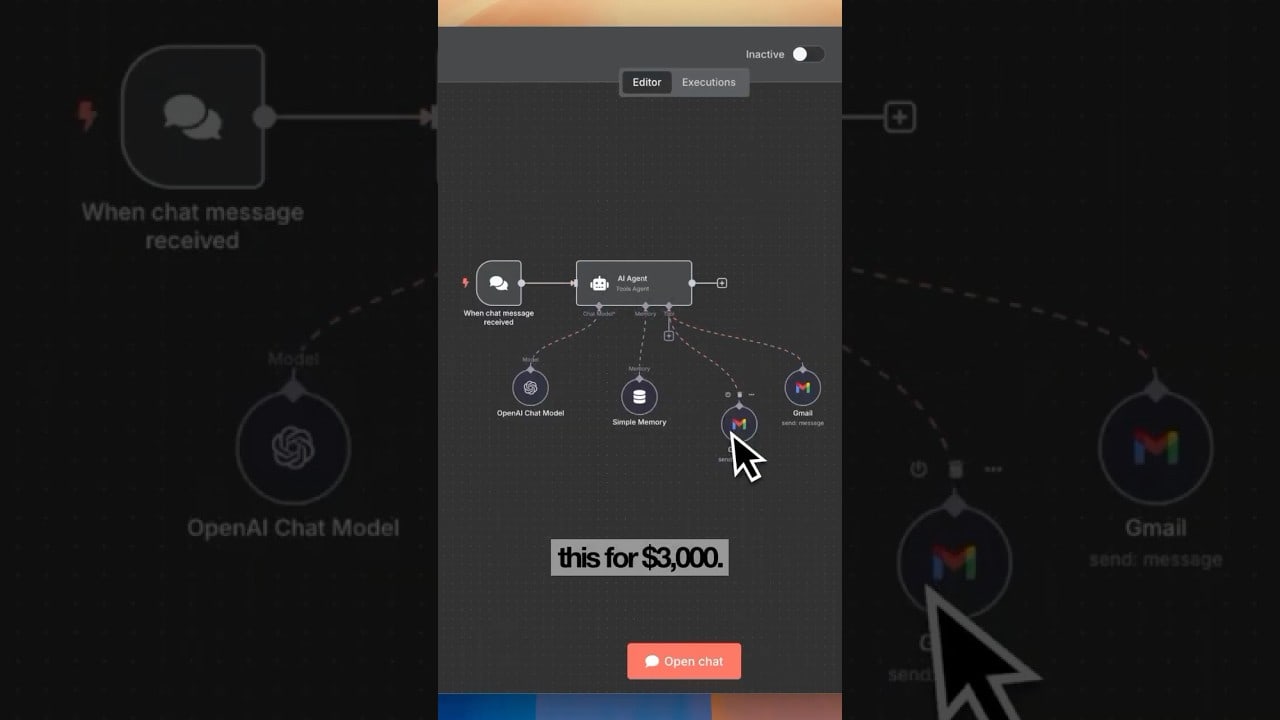
The part the n8n documentation doesn’t cover, and what cost me the most time, is error handling for the OpenAI response. The docs show a basic HTTP Request to the completions endpoint and a Set node to extract the reply. What they don’t show is what happens when the API returns a 429 in the middle of a batch, or when the response is valid JSON but the content field is empty because the model declined to generate something based on the input. Both happen in production. Neither is handled by the default error path the documentation suggests, which routes to an error node and stops. I had to build a retry loop using a Wait node and an IF node checking the status code, and a separate validation step that checks whether the content field is non-empty before passing it downstream.
None of that is hard. All of it is the kind of thing that gets left out of posts about automated freelance businesses, because those posts are written by people who want you to believe it was easy.
Stripe’s webhook payload structure changed once in six months and broke my payment processing flow. DocuSign updated their API authentication and I had to rotate credentials and update the HTTP Request node headers. Neither was n8n’s fault. Both were my problem to fix before the next scheduled workflow run.
Zapier could have done parts of this. The intake to CRM piece, maybe the invoice generation if I’d used their accounting integrations. What Zapier cannot do is the conditional logic in the middle: the multi-step extraction and validation, the retry handling on the OpenAI calls, the branching based on what the model actually returned. The moment your automation needs to know something about the data before deciding what to do next, Zapier’s path routing gets expensive and rigid in a way that n8n’s IF and Switch nodes simply don’t.
Twelve hours a week is achievable. It is not free and it is not passive. It is the output of a system you have to build, understand, and occasionally fix at inconvenient times. If you want someone else to handle the infrastructure and the error handling and the production failures, you will pay Zapier for that indefinitely and call it a business expense.
The automation is not the goal. A system that fails predictably and is fixable in twenty minutes is.

Olaitan Oladipo holds a BSc in Sociology from Olabisi Onabanjo University. He is a self-taught automation builder who has spent years inside n8n doing the work that most tutorials skip: debugging OAuth errors at 2am, migrating client automations from Make.com mid-project, fighting reverse proxy misconfigurations on AWS EC2, and figuring out through trial and error what actually holds up in production versus what only looks clean in a demo.
He is not a developer by training and not a SaaS founder. He is the person in the Discord server who actually answers the question instead of linking to the docs.
His writing on n8n Automation Tutorial covers self-hosting, AI agent workflows, tool comparisons, and the security vulnerabilities the automation industry would rather not discuss. He has built AI-assisted invoice approval flows using OpenAI function calling, connected Claude via HTTP Request nodes, and holds considered opinions about Zapier, Make.com, LangChain, and CrewAI that their marketing teams would not appreciate.
He writes for people who are technical enough to follow a tutorial but experienced enough to want the honest version.