
The first night I ran the business monitoring workflow in production it sent fourteen Slack messages between half two and five in the morning. Not because anything was actually wrong. Because I had set the revenue alert threshold to trigger if daily Stripe receipts dropped more than ten percent below the seven-day rolling average, and I had not accounted for the fact that Stripe’s payment processing data has a several-hour delay that makes Friday night numbers look catastrophically low until Saturday morning catches up. Fourteen messages. All of them technically correct. None of them useful.
I fixed the threshold logic the next day using a Code node to pull a thirty-day average instead of seven, added a time-based IF condition to suppress alerts between midnight and six, and the workflow has run quietly and actually usefully every night since. The point is not that I got it wrong. The point is that the headline version of this, the AI agent that monitors your entire business while you sleep, skips the part where you have to define what monitoring actually means for your specific business before any of this works.
Let me tell you what the workflow actually looks like, because the gap between what gets described in these pieces and what you end up building is where most people lose a day.
The core is a Schedule Trigger set to run at one-hour intervals during business hours and a reduced frequency overnight. From there, a series of HTTP Request nodes fan out to whatever data sources you care about: Stripe for revenue and failed payments, a Google Analytics API call for traffic and conversion metrics, your database via a query if you have one connected, whatever CRM or support tool your business runs on. Each of these returns JSON, and the structure of that JSON is almost never as clean as the documentation example. The Stripe charge object alone has about sixty fields and the one you want, net_amount after fees, is not at the top level. It is inside a balance_transaction object that you have to make a separate API call to retrieve if you want the real number rather than the gross charge.
I spent more time than I want to admit building the Set nodes that normalise these different API responses into a consistent data shape before any comparison logic runs. If you skip this step and try to run IF conditions directly against raw API responses from five different services, your workflow becomes unmaintainable within a week.
The AI part of this is a single HTTP Request node calling the Claude API, positioned after all the data collection and threshold checking, and its job is narrow and specific. It receives a structured summary of anything that triggered an alert threshold and returns a single paragraph explaining what it is seeing in plain language, with enough context to decide whether it warrants waking up or can wait until morning. It does not make decisions. It does not take actions. It reads numbers and writes a sentence. That is the right scope for an AI node in a monitoring workflow, and anything more ambitious than that is where I have watched these systems get unreliable.
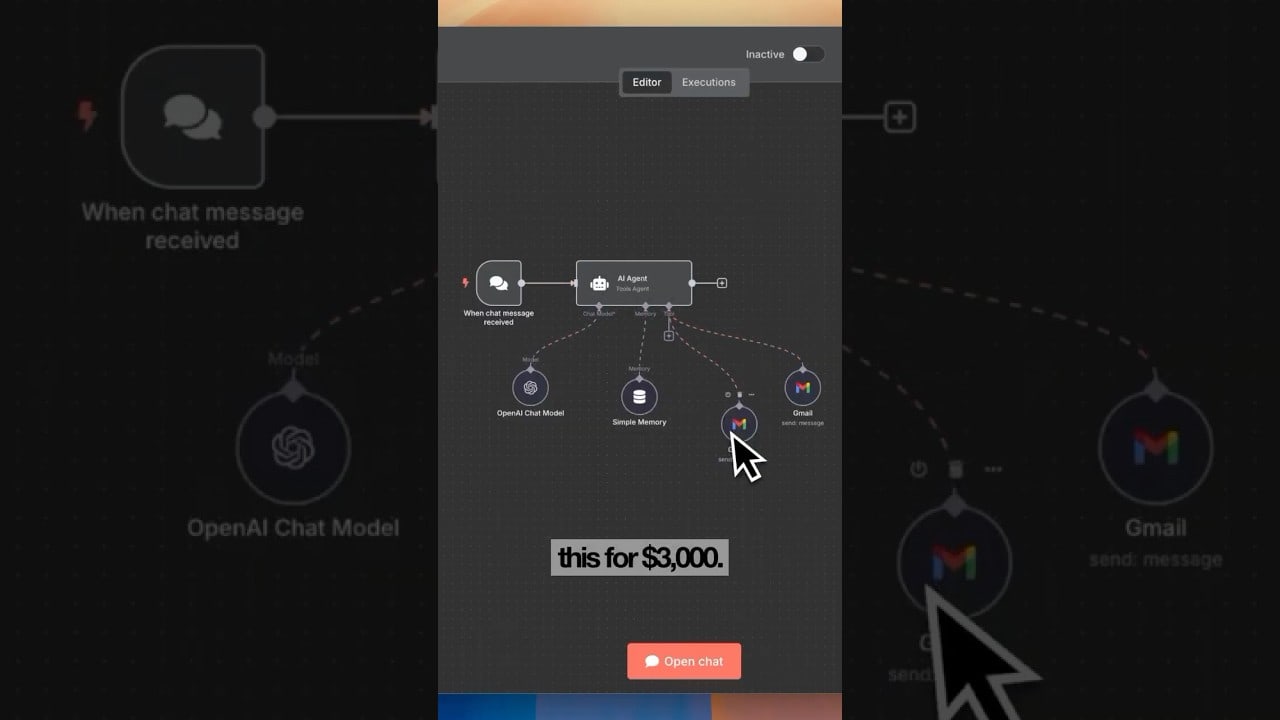
The n8n documentation for connecting to Claude via HTTP Request was where I lost about three hours, because the example in the docs at the time showed the Authorization header formatted as Bearer followed by the key, which is correct, but did not show that the base URL needs to not have a trailing slash, and the Anthropic API returns a 404 that looks identical to a routing error rather than a credential format error. I went through the credential configuration twice, regenerated the API key once, and eventually found a forum post from someone who had hit the same issue. The fix took four seconds. Finding the fix took three hours.
LangChain’s agent framework promises a version of this that is more autonomous and presumably more impressive. I have built with it. The demos are genuinely good. In production, what you get is a system that occasionally decides to call a tool three times in sequence for no clear reason, sometimes generates a plan that makes internal sense but does not match the actual API signature of the tool it is calling, and requires you to write enough Python scaffolding that you start wondering why you did not just write the whole thing in Python to begin with. For a monitoring use case where you want predictable, auditable behaviour that you can debug at three in the morning, LangChain’s current agent loop is the wrong abstraction. n8n’s explicit node graph is the right one precisely because you can see every step, inspect every input and output, and know exactly why something went wrong.
CrewAI is more interesting but I would not put it anywhere near a production monitoring system right now. Not because it is bad engineering, it is not, but because multi-agent coordination introduces failure modes that are difficult to predict and even harder to debug when they surface at inconvenient times.
The workflow I run now monitors revenue, traffic, error rates in my n8n instance itself, and a couple of external API statuses. It sends me one consolidated Slack message at seven in the morning summarising anything that moved significantly overnight, and a live alert only if something crosses a threshold I have specifically decided warrants immediate attention. It has been wrong twice in three months. Both times were my fault, not the workflow’s.
The business monitoring agent that fires alerts before you wake up is real and buildable. It just requires you to define, in explicit IF node logic, what you actually care about before the AI part has anything useful to say.

Olaitan Oladipo holds a BSc in Sociology from Olabisi Onabanjo University. He is a self-taught automation builder who has spent years inside n8n doing the work that most tutorials skip: debugging OAuth errors at 2am, migrating client automations from Make.com mid-project, fighting reverse proxy misconfigurations on AWS EC2, and figuring out through trial and error what actually holds up in production versus what only looks clean in a demo.
He is not a developer by training and not a SaaS founder. He is the person in the Discord server who actually answers the question instead of linking to the docs.
His writing on n8n Automation Tutorial covers self-hosting, AI agent workflows, tool comparisons, and the security vulnerabilities the automation industry would rather not discuss. He has built AI-assisted invoice approval flows using OpenAI function calling, connected Claude via HTTP Request nodes, and holds considered opinions about Zapier, Make.com, LangChain, and CrewAI that their marketing teams would not appreciate.
He writes for people who are technical enough to follow a tutorial but experienced enough to want the honest version.