


For the previous guide in this series, read n8n helm chart: How to deploy n8n in Kubernetes – k3s.
Langflow and n8n are both open-source automation tools, but they solve different problems. Langflow is a low-code visual builder for AI agents, RAG pipelines, and LLM applications. n8n is a workflow automation platform that connects 400-plus apps, APIs, and databases into production-ready automations. The core difference is AI-first design versus automation-first architecture.
What Is Langflow?
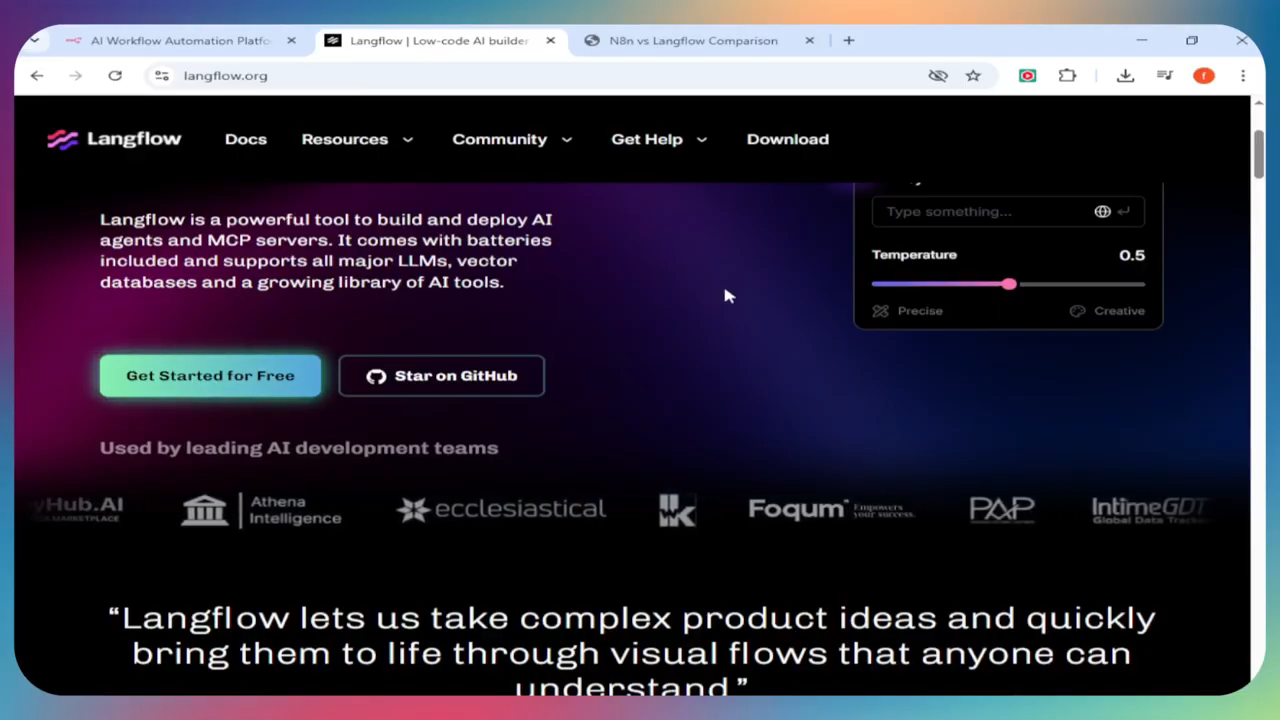
Langflow is a free, open-source, low-code visual builder for AI agents and Retrieval-Augmented Generation (RAG) applications. Its drag-and-drop interface minimises boilerplate code and supports major language models and vector databases without vendor lock-in. Teams design AI agents and MCP servers using visual state flows and reusable Python components. Version 1.8.4, released April 2026, ships improved agent nodes, MCP server export, and deeper LangGraph integration. The open-source project is MIT-licensed and free to self-host with no usage caps. Langflow supports connections to LLMs including OpenAI, Anthropic Claude, Google Gemini, Cohere, HuggingFace models, and local LLMs via Ollama. Vector database integrations include Pinecone, Weaviate, Chroma, and PostgreSQL with pgvector.
What Is n8n?
n8n is an open-source workflow automation platform that connects apps, APIs, and databases through a visual node-based editor, with full support for custom JavaScript and Python. It allows self-hosting, extends with custom code, and is designed for logic-rich automations that scale with business requirements. n8n provides full access to 400-plus native nodes and the HTTP Request node for any API, with code nodes supporting both JavaScript and Python on all self-hosted installations. AI features including LLM nodes and agent support are included with no additional licensing cost.
What Are the Key Differences Between Langflow and n8n?

6 differences separate Langflow and n8n across purpose, integrations, AI capabilities, pricing, community, and production readiness.
1. How Do Langflow and n8n Differ in Purpose?
Langflow is for building AI agents and RAG applications. n8n is for workflow automation with AI capabilities. Langflow excels at visual LangChain development, prompt chaining, and retrieval systems. n8n excels at connecting 400-plus apps with automation workflows that can include AI steps. The distinction is AI pipeline construction versus business process automation. Teams building chatbots, knowledge retrieval systems, or multi-agent AI architectures use Langflow. Teams automating CRM updates, data syncs, or multi-app business logic use n8n.
2. Which Tool Has Stronger AI and RAG Capabilities?
Langflow has stronger native AI and RAG capabilities than n8n. Langflow offers drag-and-drop LangChain components, agents, chains, and memory stores, all preconfigured for faster experimentation. Langflow dominates when it comes to RAG applications. With native database integrations for Pinecone, Chroma, and Weaviate, plus ready-to-go templates, it reduces RAG implementation time by 40% compared to manual setups. n8n’s AI features are still maturing. The AI Agent nodes are functional but there is no native knowledge-base connector. If the primary use case is building LLM applications, n8n can feel like a point solution that needs extra scaffolding.
3. Which Tool Has More Business Integrations?
n8n has significantly more business application integrations than Langflow. Langflow’s integrations outside the LLM world are narrow. It does not connect to 40 business apps the way n8n does. Observability, audit logging, and role-based access also require extra engineering work to implement in Langflow. n8n integrates natively with tools including Slack, Airtable, Notion, GitHub, HubSpot, Google Sheets, PostgreSQL, and hundreds of other SaaS platforms. The HTTP Request node extends connectivity to virtually any REST API without custom node development.
4. How Do Langflow and n8n Compare on Pricing?
Both tools are free to self-host. Real-world costs differ based on infrastructure requirements.
| Cost Factor | Langflow | n8n |
|---|---|---|
| Software licence | Free (MIT) | Free (fair-code) |
| Self-hosted cloud | Free; ~$5–$20/month infra | Free; ~$5–$15/month infra |
| Cloud managed | Free tier; ~$25/month paid plans | €24–€800/month |
| LLM API costs | Required; varies by model | Optional; included in AI nodes |
| Vector database | Required for RAG; ~$50/month+ | Not required |
| Enterprise | Custom | Custom |
Realistic total Langflow deployment costs range from $30–$100/month for solo developers to $2,000 or more per month for enterprise deployments, accounting for hosting infrastructure, LLM API usage, vector databases, and monitoring tools. n8n Cloud ranges from €24/month for the Starter plan with 2,500 executions to €800/month for the Business plan with 40,000 executions. The self-hosted Community Edition is free with unlimited executions.
5. How Do Langflow and n8n Compare in Community and GitHub Activity?
Both tools maintain active open-source communities with regular releases. Langflow has 145,927 GitHub stars and n8n has 180,112 stars. n8n has 55,975 forks, indicating strong developer engagement. n8n has been in development for 7 years compared to Langflow which began 3 years ago, suggesting n8n has more mature features and established processes. Both projects show active daily development. Langflow ships monthly releases. Version churn is high, with breaking changes landing occasionally. Teams are advised to pin versions for production deployments.
6. How Do Langflow and n8n Handle Production Readiness?
n8n is more production-ready than Langflow for business automation workloads. n8n provides execution logging, error handling, retry logic, webhook-based triggers, branching conditions, and SAML SSO on its Business plan. These features make it suitable for mission-critical business workflows. Langflow has strong visual interface capabilities and built-in monitoring and debugging tools specifically designed for AI workflows. Its self-hosting options provide complete data control and privacy. Native MCP support enables seamless integration with modern AI platforms. However, DataStax managed hosting was deprecated in March 2026 and shut down in April 2026, meaning self-hosting is now required for enterprise Langflow deployments. Visual builder limitations also emerge with complex conditional logic and deeply nested multi-agent workflows.
Langflow vs n8n: Side-by-Side Comparison
| Factor | Langflow | n8n |
|---|---|---|
| Primary use | AI agents, RAG pipelines, LLM apps | Business workflow automation |
| Licence | MIT (fully open) | Fair-code (open core) |
| GitHub stars | 145,927 | 180,112 |
| Integrations | LLMs, vector DBs, Google, Notion, Pinecone | 400-plus SaaS, APIs, databases |
| Custom code | Python | JavaScript and Python |
| RAG support | Native, preconfigured | Requires manual setup |
| Self-hosting | Yes | Yes |
| Cloud managed | Free tier; ~$25/month | €24–€800/month |
| MCP server export | Yes (v1.8+) | No |
| Production features | Improving; no SSO yet | Full: SSO, audit logs, error handling |
| Best for | AI developers, data science teams | Developers, ops teams, enterprises |
When Should You Use Langflow?
Use Langflow for 4 specific scenarios:
- RAG application development — Building document retrieval, question-answering, or knowledge-base search systems using vector databases
- LLM pipeline prototyping — Rapidly testing prompt chains, memory stores, and AI agent architectures without writing infrastructure code
- Multi-agent systems — Designing stateful agent coordination using LangGraph integration and MCP server export
- AI-first teams — Data scientists and ML engineers who prefer Python-native components and want visual control over LLM workflows
Langflow use cases include an agentic RAG assistant drafting customer responses from product docs, a coding agent that plans tasks and writes code across a repo, an enterprise knowledge base search with vector DBs and guardrails, and a document processing pipeline for ingestion, chunking, and summarisation.
When Should You Use n8n?
Use n8n for 4 specific scenarios:
- Multi-app business automation — Connecting CRMs, databases, Slack, GitHub, email, and hundreds of SaaS tools into reliable production workflows
- Data privacy requirements — Self-hosting on private infrastructure to meet compliance requirements in healthcare, finance, or legal sectors
- AI-augmented business processes — Adding LLM steps to existing automation workflows using GPT-4, Claude, or local Ollama models via LangChain nodes
- High-volume, mission-critical workflows — Running automations with execution logging, error handling, retry logic, and audit trails
Can Langflow and n8n Work Together?
Yes. The 2 tools are architecturally complementary. A mature enterprise AI setup uses Langflow to handle the RAG pipeline and agent design, and n8n to orchestrate all the business logic around it, handling triggers, integrations, error handling, and logging. Each tool performs what it does best. A practical example includes 3 steps:
- Langflow processes a document retrieval query and returns an AI-generated response via its MCP server endpoint
- n8n receives the output via webhook, formats the data, and routes it to a CRM or Slack channel
- n8n logs the execution and triggers follow-up actions based on the response content
This architecture uses Langflow for AI pipeline design and n8n for production-grade business logic execution.
Langflow vs n8n: Which Tool Should You Choose?
Choose Langflow when the primary goal is building AI agents, RAG systems, or LLM-powered applications with Python-native components and visual pipeline design. Choose n8n when the primary goal is connecting business applications, automating multi-step processes, and running production workflows with deep integration coverage and full data control. Use Langflow for AI-first applications. Use n8n for automation-first workflows with AI enhancement. Teams building enterprise AI infrastructure use both together, with Langflow handling intelligent computation and n8n handling business logic, routing, and system integration.


Olaitan Oladipo holds a BSc in Sociology from Olabisi Onabanjo University. He is a self-taught automation builder who has spent years inside n8n doing the work that most tutorials skip: debugging OAuth errors at 2am, migrating client automations from Make.com mid-project, fighting reverse proxy misconfigurations on AWS EC2, and figuring out through trial and error what actually holds up in production versus what only looks clean in a demo.
He is not a developer by training and not a SaaS founder. He is the person in the Discord server who actually answers the question instead of linking to the docs.
His writing on n8n Automation Tutorial covers self-hosting, AI agent workflows, tool comparisons, and the security vulnerabilities the automation industry would rather not discuss. He has built AI-assisted invoice approval flows using OpenAI function calling, connected Claude via HTTP Request nodes, and holds considered opinions about Zapier, Make.com, LangChain, and CrewAI that their marketing teams would not appreciate.
He writes for people who are technical enough to follow a tutorial but experienced enough to want the honest version.


