
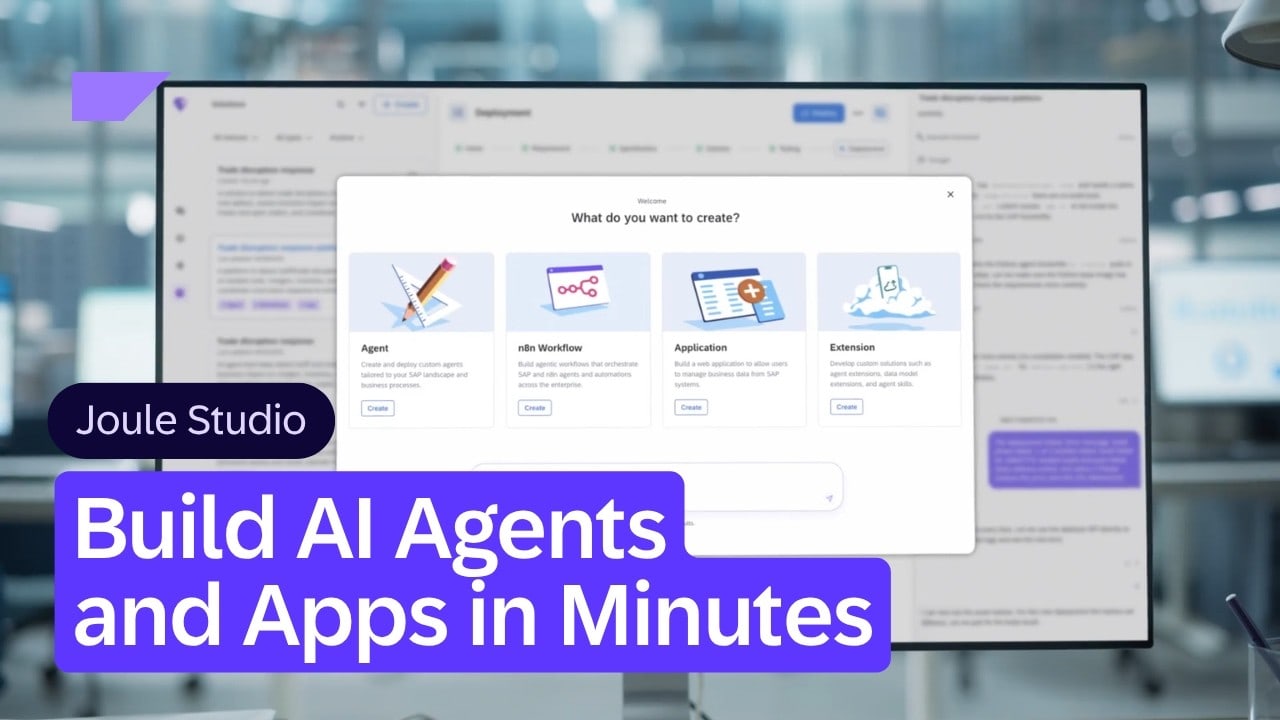
I was in the middle of a Code node trying to flatten a deeply nested SAP API response when the Joule Studio announcement dropped in my feed. The response had come back from an S/4HANA endpoint with the actual data I needed sitting at items[0].results.records.entry.content.properties, which is the kind of JSON structure that makes you understand why enterprise developers drink. I had a Code node open, I was writing a recursive flattening function, and my first thought when I read the headline was: this is exactly the problem they are trying to solve. And my second thought was: they have no idea what they just unleashed.
SAP embedding n8n into Joule Studio is not a product announcement. It is a structural decision that changes the relationship between enterprise software and the automation layer, and I do not think the people writing about it from a business strategy angle fully understand what it means in practice because most of them have never built a workflow that touches an SAP system and discovered what that actually involves.
Let me tell you what it actually involves.
SAP systems are not APIs in the modern sense. They are decades of business logic wrapped in interfaces that have been extended and re-extended until the data model underneath them requires a specialist to navigate. Getting data out of SAP into anything else has historically meant either paying for middleware that costs more than most startups raise in a seed round, or convincing your SAP administrator to expose a BAPI or an OData endpoint and then spending two weeks with the documentation figuring out why your GET request is returning XML in a format that no current XML parser handles gracefully by default.
I built an n8n workflow last year that pulled purchase order data from an SAP system via an OData endpoint. The endpoint was technically exposed. The authentication was working. The HTTP Request node was returning 200. And the response body was a structure so far from what the endpoint documentation described that I spent four hours convinced I had the wrong endpoint before I realised that the documentation was written for an older version of the API and the current version had added three additional nesting levels without updating the published schema. I found the actual structure by printing the raw response to a Set node and reading it manually. There is no elegant version of that story. It was just time.
What Joule Studio with embedded n8n does, if it works the way the architecture implies, is put the workflow engine inside the system that owns the data instead of outside it trying to reach in. That is not a minor convenience. That is a different security model, a different latency model, and a different permission model. When your n8n instance is external and hitting an SAP API, you are negotiating credentials, managing token refresh, handling rate limits, and praying that the network path between your EC2 instance and the SAP environment does not introduce timeouts that cause your workflow to fail silently and leave the process in a half-completed state. I have debugged that specific failure mode more than once. It is not fun to explain to a client.
If n8n runs inside the SAP environment, those problems either disappear or become SAP’s problems to solve, which from the perspective of someone who has been solving them manually is an enormous improvement.
Here is what I think the enterprise software market has not fully processed yet. SAP just told every company that uses their software that workflow automation is now a first-class feature of the platform, not a third-party integration concern. That is the same move that Salesforce made when they embedded Flow into the platform instead of expecting everyone to use Zapier to connect Salesforce to itself. The consequence of that move is that the companies who were selling middleware and integration services on top of Salesforce either had to move up the value chain or watch their revenue compress as the platform absorbed what they were doing.
The same thing is about to happen in the SAP ecosystem, and the integration vendors who have been selling expensive middleware to connect SAP to the rest of the world should be paying attention to this announcement in a way that goes beyond a LinkedIn reaction.
I will say something about LangChain here because Joule is an AI assistant and the workflow automation embedding is going to intersect with AI agent patterns. LangChain is impressive in a demo. It is genuinely painful in production, not because the concept is wrong but because the abstraction layer it puts over the underlying model calls makes debugging feel like trying to find a fault in a circuit by looking at the outside of the box. When something goes wrong in a LangChain agent chain at three in the morning you are reading stack traces that tell you which abstraction failed without telling you what the actual API call was or what the model actually returned. n8n’s approach of exposing the HTTP Request node directly and letting you see the raw request and response in the execution log is, for production work, worth more than any amount of abstraction elegance.
If Joule Studio’s AI features are built on n8n’s execution model rather than a LangChain-style abstraction, that is quietly one of the better architectural decisions SAP could have made.
The honest takeaway is this: enterprise software has always had an automation gap between what the system could technically do and what a business user could actually configure without writing ABAP. n8n inside Joule Studio is SAP’s bet that they can close that gap with a tool that is genuinely capable of the complexity enterprise workflows require, rather than a simplified interface that breaks the moment your logic gets serious.
Whether SAP’s implementation layer lets n8n be n8n, or wraps it until it becomes something else entirely, is the question I am watching.

Olaitan Oladipo holds a BSc in Sociology from Olabisi Onabanjo University. He is a self-taught automation builder who has spent years inside n8n doing the work that most tutorials skip: debugging OAuth errors at 2am, migrating client automations from Make.com mid-project, fighting reverse proxy misconfigurations on AWS EC2, and figuring out through trial and error what actually holds up in production versus what only looks clean in a demo.
He is not a developer by training and not a SaaS founder. He is the person in the Discord server who actually answers the question instead of linking to the docs.
His writing on n8n Automation Tutorial covers self-hosting, AI agent workflows, tool comparisons, and the security vulnerabilities the automation industry would rather not discuss. He has built AI-assisted invoice approval flows using OpenAI function calling, connected Claude via HTTP Request nodes, and holds considered opinions about Zapier, Make.com, LangChain, and CrewAI that their marketing teams would not appreciate.
He writes for people who are technical enough to follow a tutorial but experienced enough to want the honest version.